
Goodbye, Kobe
On 27 January 2020 by BrianI believe that there is intrinsic value in working hard, that professional pride is admirable, a virtue unto itself. A good day’s work means that you tried your best, that you attempted to put out into the world an effort worthy of your existence. It’s a notion I’ve grown up with, and hold to this day.
This belief is why, despite the stress, the hours, the bullshit that went into working conventions at my previous job, I loved being a part of it. Unlike my day job, where tasks can come and go, responsibilities fly up and down in priority, putting together an event means juggling it all at once, with a definitive timeline and finite resources. It was an experience with a concrete goal, discrete steps to survive, and challenges that pushed my ability to adapt and prepare. It was hard work. At an event, I could break down each action I took to its contribution to success. Every time I needed that extra HDMI cable I packed, I earned a point of vindication. Every time the games loaded on the first try, I earned a point of vindication. Every time my AV wiring worked as I drew it up, I earned a point of vindication.
Every time I used something I meticulously prepared for, especially in those 1-in-100 scenarios, I was calling out “Kobe!” like I was hitting a buzzer beating basket.
I haven’t considered where that drive to prepare or work hard came from, not for a long while. I absolutely idolized his work ethic growing up, and that passion has been an aspiration I’ve had, even as I realize that I’ve become someone different than I expected when I first learned about him. My feelings about Kobe have only grown more frustrating over time. He is decidedly irredeemable to me because of the rape that he committed, and there is no amount of admiration or inspiration that he can imbue that will eclipse that. I don’t think I can do justice to the words needed to break down this complication of perception, but please read Dave Zirin’s impeccable article, “Wrestling with Kobe Bryant’s Forgotten Apology.” It echoes a lot of that legacy, especially in light of America today. In addition, Albert Burneko’s reflection on Kobe succinctly echoes the internal dichotomy:
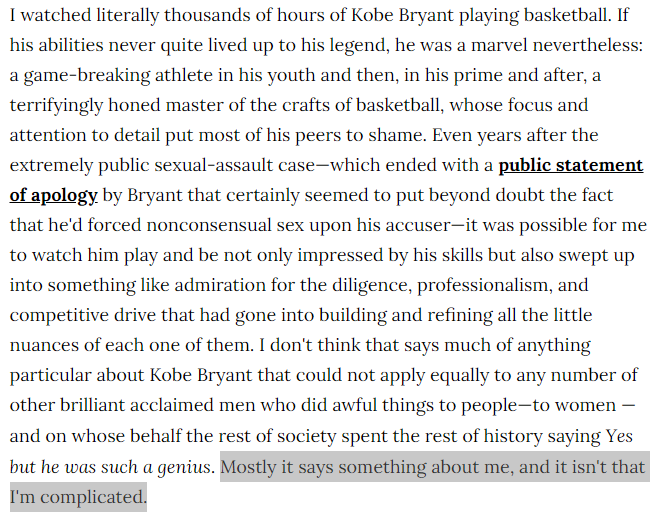
The fact remains, though, that I admired Kobe for how hard he worked for his dreams. His legend impresses upon the world that a focus and determination for success begets success. I’ve internalized that belief in the form of professional pride, and I am definitely proud of what work I have done in my career. As I think about it, though, it turns out just as Kobe’s identity is compromised, so are my beliefs. I hate that I care this much, but I do. That convention bullshit I mentioned is just one example, where people took advantage of my work ethic. I told myself it was worth it, because I was proud of having accomplished something for myself, for the team, and the accolades of the peers I respect only reinforced my resolve, even at my own detriment. Even now I get notoriously sick after any conventions, even the ones I don’t work. It’s all quite a paradox.
A couple colleagues challenged me on this as recently as last week, arguing different sides about what our responsibilities and workloads are supposed to be like. It was all a deeply-rooted drama that spanned years before I started at this current job, and I honestly wanted no part of it.
“I don’t care who does the work. I know what my job is, what my responsibilities are,” I said. “If I don’t have enough time, I’ll say so. If I have to prioritize one task over another, I’ll say so. I really don’t care if either are you are doing the work or none at all. I know what I need to do and I only care about doing that well.”
“Well, Brian, it’s not up to you to determine if you did a good job, you’ll see,” they retorted.
I’ll admit, my mindset is naive, especially when I consider how long I’ve held on to it. I remember one night, as a young teenager, my parents arguing downstairs, loud enough to keep me awake and worry for my sister. Like many nights before and after, I went down to mediate. This one night, though, I managed to keep their attention long enough to ask questions rather than just trying to get them to calm down. I wanted to impress upon them how I was proud of them.
“Don’t you care about your work? Dad, you build airplanes. Mom, you build computers. Don’t you understand how cool that is? Don’t you take pride that your hard work and effort has made something tangible in the world?”
Again, it was a naive notion. Now I can see how dangerous that mindset can be, how less ethical people can capitalize on that idea of passion and enforce working conditions that undermine my well-being. At the time though, I just wanted my parents to know I admired how hard they worked. If I could do that, maybe they’d stop fighting. And they did, but only to teach me a lesson. My parents flat out rejected me instead. “We work hard so that we can afford to live, to provide for you and your sister. Do you think we would commute for hours, that we would choose to suffer our jobs, because we want to work? We work because we have to survive, it’s not some kind of privilege that we are grateful for. We are only grateful that we are alive at all.”
For a time, I couldn’t understand them. I tend to point to this moment as one of the first times I realized my parents were human, and not just Mom and Dad. Why was I working hard in school, if it meant that I’d hate the work I had to do? Why should I listen to my parents if they didn’t believe in hard work? Kobe worked his ass off and look what he accomplished. Working for fame couldn’t possibly be enough. He needed to be the best because he believed the work and effort it took was worth it, that it was everything. I believed it too, and yet, here my parents were, putting some reality in my dreams.
I understand my parents better now. Work was a necessary component of their struggle, it was paramount to their survival, burned into them as refugees fleeing the home that turned on them. It’s something I’ll hopefully never have to experience. On the other hand, someone like me, like Kobe, has the privilege to decide what kind of work they will do. But then, isn’t hard work and success how I honor my parents’ sacrifice?
It makes me think of my sister, who I’ve had to spend as much time raising as my parents at times. I’m not sure she’ll agree, but I believe that both Kobe and I taught her the importance of professional pride. I remember talking to her about building confidence by owning her work. Draw on your work to project your success, and dictate your own self-worth to the world.
I admit some naivete in this too. Kobe’s obsession with hard work is well-documented, and I fear that the world twists the lesson into something that takes advantage of me and her. I remember times where my sister made a mistake in school and at work, and she broke down because it had to mean she didn’t work hard enough, somewhere and somehow, that somehow despite studying for days in a row and working 12 hour days and 60 hour weeks was somehow not enough. She could have worked harder, could have prevented the mistake. This kind of stress has put literal strain in her body. It’s clear now that I can trace those kinds of mistakes to overwork, a byproduct of the systemic issues that management did not want to admit, who instead placed blame on my sister and her team, rather than supporting and positioning them to succeed.
Beyond the bullshit that comes with corporate structure, though, all I wanted to teach her was to work hard so that she could be confident about her self, her self-worth. If she could speak to the work, she could defeat her anxieties and imposter syndrome. If she could prepare herself for that 1-in-100 scenario, she would be ready for every scenario. Preparation breeds success. Kobe hits the game winner because he’s practiced the shot 100 times, for the one time he’ll need it.
In the end, is that hard work worth it? What value does that mentality have? Kobe’s still dead. My parents would say no, happiness is found elsewhere. Everyone on that helicopter is dead. Does that hard work I put out mean anything? Kobe’s still dead.
I laid in bed and went in circles with this train of thought with my partner. How I could feel sad for Kobe, reflecting on how much I now push back on the things he represented to me? Even worse, why does his passing drive me to tears when I feel like I felt less sad about family passing? What does it say about me when there are people who literally fed me growing up that I think about less? Can I say these lessons I’ve taken from him are worthwhile?
“The answer is yes. It’s okay for you to feel sad, it does mean something because it means something to you. He inspired you. The sadness you feel is valid, because someone taught you a part of who you are, and now they’re gone. Every relationship is different, and that’s okay. You can’t measure sadness, it will always be the heaviest thing you carry at any moment in time. It isn’t that Kobe is more important to you than your family, but that just as much as they took care of you, Kobe taught you something that defines you as a person.
“And now he’s gone, and losing him is sad, regardless of everything else he is and he’s done, because you aren’t who you are today if he wasn’t a part of your life.”